Often one must attempt to do something multiple times before succeeding at it--and enjoying it. The first time I read to read Beckett's Endgame, I stopped after about 15 pages and said (to myself... not out loud...), "I don't understand what's going on. I don't know who these people are, where they are, what they are, what they're doing, or what they want. There is no forward progress. I am utterly nonplussed. In spite of the fact that I have been told by reputable authorities that this is one of the greatest plays in the English language, I derive no enjoyment from reading it. I give up," and I gave up and put the book back on the shelf. Six months or so later, I tried again. Perhaps I approached it with a different mindset, or perhaps I was in a lighter (and less verbose) mood that particular day, but not only did I finish it on the second try, I absolutely loved it. I've reread it once or twice since then, and it is now one of my favorite plays. (And the moral of this story is...)
Similarly, I stopped at about Chapter 7 of the Silmarillion the first time I read it because I forgot who begat whom by what and I was bored by all the highfalutin language, but on the second try, a few years later, I finished and enjoyed it--though not as much as I did Endgame. The first few times I tried to start a journal, it swiftly turned into a list of what I'd eaten and what computer games I'd played each day, and I got bored and stopped. After a while, though, I started being a little more observant about my diurnal activities, and it became more enjoyable to keep a journal and write random stuff in it.
The upshot of all this is that I'm trying, yet again, to do the same thing with blogging. I've tried and failed to keep up with several blogs, but I'm going to try one more time. I have a new, firm idea in mind for what to write about, with the occasional diversion, of course: the world through the eyes of a wannabe musician, with musical criticism, reviews, recommendations, soliloquys, and plenty of griping about how hard it is to write lyrics. I hope to emphasize the universal and cross-cultural aspect of music, and bring to light any interesting "fusion" music which I may encounter. I encourage you, Gentle Reader, to do the same. There will also be periodic rampages on my other interests, such as ice hockey, Walkers Shortbread, and my cats.
For anyone who has taken the time to read all this, let me assure you that future posts will be far more concise, pictorial, and linky, which, if it's not a word, should be.
Wednesday, July 4, 2007

Tuesday, February 27, 2007
Resonations
Jerry Douglas is almost inarguably the greatest dobro player who ever lived, with the possible exception of Josh Graves (who was, interestingly enough, Douglas' dobro mentor), though "ever lived" is not quite so grand of an accolade when you consider that the dobro has been around for less than a century. Last night he rocked a full house at the Emerson Cultural Center with his maniacal dobro skills and impeccable band, bringing a caliber of musicianship that is rarely seen in Bozeman.
The opening act, a local group called ThermalGrass, was driven out of the audience's mind by the main show, but they were certainly competent musicians in their own right. Their 19-year-old guitar player, named Ian Fleming, is incredibly good. Not only does he have the skill to play blinding flurries of notes up and down the neck of the guitar, but he has the musical taste to mix in bends, pauses, bluesy riffs, and double stops. I predict that he will go on to great things. The other musicians were very good as well, including Tom Murphy, bluegrass aficionado and owner of Norris Hot Springs, where various bluegrass acts are brought in to entertain the soakers. The bass was up way too loud at the beginning, and they turned it down slightly, though not enough. The songs they selected were interesting, either bluegrass standards (Red Haired Boy, Cherokee Shuffle) which were tweaked somehow, or unfamiliar tunes brought into the bluegrass enclave. Then we got to the main attraction.
The Jerry Douglas band, consisting of dobro, fiddle, guitar, upright electric bass, and drums, played about an hour and a half to two hours of entirely instrumental tunes of various genres, generally running six or eight minutes each. Because of Douglas' musical ability to do anything he wants, he also reserves the right to play whatever he wants, be it bluegrass, rock, jazz, Cajun, blues, honky-tonk, or anything else. Though his foundations are in bluegrass, he has stretched and broken the barriers of bluegrass and spilled over into other genres, most notably jazz. He sampled these genres throughout the night, and none of the tunes had quite the same feel to them, which is a good thing considering the monotony of the dobro as a lead instrument and the lack of vocals.
All of the tunes had complex arrangements, with various instruments moving in and out of each other in a precisely orchestrated fashion, a Tool-like fondness for changing time signatures, a total dearth of conventional chord progressions, and frequent changes in speed or groove during one song. The musicians accomplished this without a trace of effort, and in fact the whole concert had a mood of "another night, another show" until maybe halfway through: the musicians seemed, well, not exactly bored, but casual in their playing. Nobody jumped around very much or felt obliged to headbang or rock out (except the drummer, of course, and even he was rather restrained); the musicians stayed fairly static, with Douglas occasionally moseying around during somebody else's break. For himself, he never got too worked up even when playing the most difficult-looking material, preferring to let his hands speak for themselves.
 On their first number, I thought the rhythm section was too intrusive and even drowned out the lead instruments to some degree, but either they fixed the levels (which they were tweaking slightly all night) or I got used to it, because as time went on they seemed to settle into it more. Also as the night went on, they progressed from the more thoughtful, jazzy numbers to the more straightforward, though still trippy, bluegrass numbers, which was a good idea since starting with the faster stuff and moving to the more melodically complex stuff could easily have made the audience restless. The bass player had a few solos, the drummer had one, and the fiddler and guitarist had one in almost every song. The whole sound, too, seemed to change as the night went on: initially the backup emitted a sort of constant hum, probably from the lingering bass, and the rhythm seemed not so much to pulsate or rollick as to sort of ooze, though this straightened out eventually. Or, again, maybe I just got used to it. The band's sound struck me as one great resonation, like everyone was imitating the resonator guitar: the fiddle's agonizingly pure tone that sometimes provided a little too much resonance for the mikes to handle, the bass's lingering hum, even the blasting cymbals- and of course the warbling, bulbous sound of the dobro.
The rhythm was so precise as to provide practically metronomic consistency, and all of the instrumental breaks were delivered with the same spirit of total clarity and precision. Visualizing this precise sound does not give me an image of many single precise points, however- more one of rolling hills, perhaps because the points were played with such dizzying clarity that they all meshed together into one great resonation.
Many things about the Jerry Douglas Band reminded me of another highly recommended bluegrass/jazz act: Béla Fleck and the Flecktones. Aside from the fact that Douglas has recorded many times with Fleck and also claims to be responsible for giving the Flecktones' bass player ("Future Man") his moniker, they have many musical similarities: no vocals, instead having the bandleader fill the part of vocalist with his banjo or dobro; stylistic affinities, such as the vast range of genres which both bands encompass and the contempt of static time signatures; analogous instrumentation, like banjo=dobro, bass guitar player who plays a lot of solos=upright electric bass player who plays a lot of solos, drum guitar dude=drummer, and especially fiddler=saxophonist, because many of the chillingly clear, 6th and 9th based, higher-string adventures which Douglas' fiddle player (Luke Bulla, who has previously ranked 2nd at Grand Masters') embarked on reminded me a lot of Jeff Coffin's sax wizardry; and the same sort of background hum which I mentioned before. Fleck and Douglas also write a lot of their own stuff, much of which has no hummable melody and seems purely experimental.
Having the authority to play and write whatever sort of music he wanted, Douglas didn't seem particularly concerned with showboating, but was more interested in pushing the limits of what could still be conceivably called "bluegrass" and the tonal limits of his chosen instrument. The dobro is pretty basic in terms of what tones it can produce, but Douglas is determined to coerce the instrument to produce every different tone it is capable of. Some of the tunes were laidback and mellow, some punchy and sparkling, some tense and pulsating. Then, about halfway through, the rest of the band departed the stage, and Douglas and his dobro went to work in a long, powerful, variegated, heavily-fermataed medley of particularly bluesy bluegrass tunes. It was the awesomest thing I've heard in a while, as if he was forcefully reminding the doubters that "Yeah, I really am the best ever."
The opening act, a local group called ThermalGrass, was driven out of the audience's mind by the main show, but they were certainly competent musicians in their own right. Their 19-year-old guitar player, named Ian Fleming, is incredibly good. Not only does he have the skill to play blinding flurries of notes up and down the neck of the guitar, but he has the musical taste to mix in bends, pauses, bluesy riffs, and double stops. I predict that he will go on to great things. The other musicians were very good as well, including Tom Murphy, bluegrass aficionado and owner of Norris Hot Springs, where various bluegrass acts are brought in to entertain the soakers. The bass was up way too loud at the beginning, and they turned it down slightly, though not enough. The songs they selected were interesting, either bluegrass standards (Red Haired Boy, Cherokee Shuffle) which were tweaked somehow, or unfamiliar tunes brought into the bluegrass enclave. Then we got to the main attraction.
The Jerry Douglas band, consisting of dobro, fiddle, guitar, upright electric bass, and drums, played about an hour and a half to two hours of entirely instrumental tunes of various genres, generally running six or eight minutes each. Because of Douglas' musical ability to do anything he wants, he also reserves the right to play whatever he wants, be it bluegrass, rock, jazz, Cajun, blues, honky-tonk, or anything else. Though his foundations are in bluegrass, he has stretched and broken the barriers of bluegrass and spilled over into other genres, most notably jazz. He sampled these genres throughout the night, and none of the tunes had quite the same feel to them, which is a good thing considering the monotony of the dobro as a lead instrument and the lack of vocals.
All of the tunes had complex arrangements, with various instruments moving in and out of each other in a precisely orchestrated fashion, a Tool-like fondness for changing time signatures, a total dearth of conventional chord progressions, and frequent changes in speed or groove during one song. The musicians accomplished this without a trace of effort, and in fact the whole concert had a mood of "another night, another show" until maybe halfway through: the musicians seemed, well, not exactly bored, but casual in their playing. Nobody jumped around very much or felt obliged to headbang or rock out (except the drummer, of course, and even he was rather restrained); the musicians stayed fairly static, with Douglas occasionally moseying around during somebody else's break. For himself, he never got too worked up even when playing the most difficult-looking material, preferring to let his hands speak for themselves.
 On their first number, I thought the rhythm section was too intrusive and even drowned out the lead instruments to some degree, but either they fixed the levels (which they were tweaking slightly all night) or I got used to it, because as time went on they seemed to settle into it more. Also as the night went on, they progressed from the more thoughtful, jazzy numbers to the more straightforward, though still trippy, bluegrass numbers, which was a good idea since starting with the faster stuff and moving to the more melodically complex stuff could easily have made the audience restless. The bass player had a few solos, the drummer had one, and the fiddler and guitarist had one in almost every song. The whole sound, too, seemed to change as the night went on: initially the backup emitted a sort of constant hum, probably from the lingering bass, and the rhythm seemed not so much to pulsate or rollick as to sort of ooze, though this straightened out eventually. Or, again, maybe I just got used to it. The band's sound struck me as one great resonation, like everyone was imitating the resonator guitar: the fiddle's agonizingly pure tone that sometimes provided a little too much resonance for the mikes to handle, the bass's lingering hum, even the blasting cymbals- and of course the warbling, bulbous sound of the dobro.
 The rhythm was so precise as to provide practically metronomic consistency, and all of the instrumental breaks were delivered with the same spirit of total clarity and precision. Visualizing this precise sound does not give me an image of many single precise points, however- more one of rolling hills, perhaps because the points were played with such dizzying clarity that they all meshed together into one great resonation.
Many things about the Jerry Douglas Band reminded me of another highly recommended bluegrass/jazz act: Béla Fleck and the Flecktones. Aside from the fact that Douglas has recorded many times with Fleck and also claims to be responsible for giving the Flecktones' bass player ("Future Man") his moniker, they have many musical similarities: no vocals, instead having the bandleader fill the part of vocalist with his banjo or dobro; stylistic affinities, such as the vast range of genres which both bands encompass and the contempt of static time signatures; analogous instrumentation, like banjo=dobro, bass guitar player who plays a lot of solos=upright electric bass player who plays a lot of solos, drum guitar dude=drummer, and especially fiddler=saxophonist, because many of the chillingly clear, 6th and 9th based, higher-string adventures which Douglas' fiddle player (Luke Bulla, who has previously ranked 2nd at Grand Masters') embarked on reminded me a lot of Jeff Coffin's sax wizardry; and the same sort of background hum which I mentioned before. Fleck and Douglas also write a lot of their own stuff, much of which has no hummable melody and seems purely experimental.
Having the authority to play and write whatever sort of music he wanted, Douglas didn't seem particularly concerned with showboating, but was more interested in pushing the limits of what could still be conceivably called "bluegrass" and the tonal limits of his chosen instrument. The dobro is pretty basic in terms of what tones it can produce, but Douglas is determined to coerce the instrument to produce every different tone it is capable of. Some of the tunes were laidback and mellow, some punchy and sparkling, some tense and pulsating. Then, about halfway through, the rest of the band departed the stage, and Douglas and his dobro went to work in a long, powerful, variegated, heavily-fermataed medley of particularly bluesy bluegrass tunes. It was the awesomest thing I've heard in a while, as if he was forcefully reminding the doubters that "Yeah, I really am the best ever."
Sunday, February 11, 2007
Hucksterism
hucksterism \'huk-stuhr,iz-uhm\ noun
1: persuasive showmanship in advertising or selling : COMMERCIALISM
Having not updated my blog in a while, being occupied with other exciting things such as the furtherment of learning and whatnot, I feel that the time has come for some words to show that I do in fact wish to continue being blogtastic. The Grammy Awards present a fine opportunity.
Each time one such awards show comes around every year, I am freshly astonished by the unstable but insistent veneer placed over the proceedings. Or, rather, the blatant and aggressive commercialism, the over-the-top musical numbers, the emphasis on business rather than art, the forced feel-goody-ness. This applies not just to the Grammys but all of its various cousins-german: Emmys, Tonys, Oscars, Golden Globes, heck, even the SAGs are a little too glossed-over for my taste. Being a musician myself, I like to imagine the artistic ideal of art for art's sake, rather than art for survival's sake, and seeing the Biz in action is a new disillusionment every time.
 There were some impressive musical features of this year's show, however. John Mayer caused my ears to perk up (which he also did last year sometime with his cool single "Daughters"), as did Gnarls Barkley (with vocals by the bizarre-looking but excellent-sounding Cee-Lo Green, seen at right) and Corinne Rae Bailey. Carrie Underwood raised herself in my esteem slightly (counteracting her Jesus the Truck Driver song) by covering Bob Wills and Graham Parsons songs, and Christina Aguilera raised herself in my esteem vastly with her James Brown imitation. Like so many other female music stars, they're hot and they can sing but their material is so awful that I have no desire to listen to it. Neither am I a tremendous fan of the excessive melisma popular among doyens of popular music. Justin Timberlake, oddly enough, wrote a halfway decent song called "What Goes Around Comes Around," which was tolerable even bypassing the cliches and... well, the fact that it's Justin Timberlake, after all. It also has very similar chord changes to the Staind song "It's Been A While", which I was mucking with on the guitar earlier today.
Wyclef Jean made me laugh by singing "u really swing it like u ya come 4rm colombia" during "Hips Don't Lie" with Shakira, who is always entertaining to watch but was slightly lacking in vocal force tonight due to being out of breath from dancing. And, of course, the Dixie Chicks, a personal favorite, received plenty of recognition from the Academy (or whatever the music one is referred to as) for their latest excellent record (album? what's the difference?) "Taking the Long Way." Natalie Maines showed some tactful restraint in not assaulting Bush or the government or the establishment or anything in her acceptance speech. Perhaps she's figured out that America doesn't like free speech. Hm.
Returning to the commercialism theme, the almost grotesque spectacles of the various musical numbers (with some tasteful exceptions such as the Dixie Chicks and weird-voiced James Blunt) were a little too much. The pyrotechnics, strobe lights, choruses of scantily-clad women and so on are only to be expected from such a major concert- but in order to fit all of this in, they had to sacrifice presentations of some pretty major awards, which I guess were not pop enough to make it on the air, and the performances of some pretty major songs. So I'll wait until next year, shaking my head at the way it is and doing nothing to alter it, because actually, in the grand scheme of things, there are a lot worse problems in the world than the fact that some of my favorite bands failed to be acknowledged at the Grammy Awards.
Sunday, January 7, 2007
Tonsor Retonsus
tonsorial \tahn'sohr-ee-uhl\ adjective
1: of or relating to a barber or his work
I had a haircut a few days ago, and I went from being very shaggy to very short, so now my head feels about 2 lbs. lighter. I also can't headbang quite as well. The haircutter based this haircut on a picture of George Clooney and assured me that women would be falling into my lap. We'll see how that prediction turns out.
Yesterday I went skiing for the first time in a long time, grandly girded with new (to me) equipment. I hung out on the bunny-hill runs for a while, then stupidly decided to take on all my favorite blue- and black- (i.e. medium and difficult) level runs. One or two turned out to be a little steeper than I had anticipated, and I found myself digging in to the side of the mountain with my skis to keep from tumbling off. Attempting to move forward in this position requires the exertion of one's leg muscles, and mine were somewhat withered from disuse, the upshot of which is that my thighs and especially my calves felt like they had been injected with gasoline and set alight. But I valiantly stuck it out until the end, went home, and was more or less unable to walk or even remain standing for more than a few seconds. They're better today, as in "I can walk," ("Mein Führer, I can walk!") but now my arms hurt. Oh well, no pain, no gain. And it was a hell of a lot of fun.
 In cultural news, I just finished reading The Book of Sand, a collection of short stories by Jorge Luis Borges. I've also read his The Aleph and Other Stories, and his Labyrinths is in the stack. He's a wonderful writer, cosmopolitan and literate but distinctly South American, phantasmagorical yet punishingly real. He deals often with religion, philosophy, and infinity (which reminds me of an interesting but long essay on time my dad sent me recently), and often uses vividly pictorial metaphors: circles and spheres, cubes, mazes, darkness (Borges was blind), sand. His stories are horrific (There Are More Things, which was dedicated to H.P. Lovecraft), A Biography of Tadeo Isidoro Cruz, The Sect of the Thirty), fantastical (The Aleph, The Book of Sand, The Other), figurative (The Circular Ruins (which was the subject of The Borges Project, a fascinating multinational theatre project covered in American Theatre), The Two Kings and the Two Labyrinths, The Mirror and the Mask), and realistic (The Bribe, The Night of the Gifts, Ulrike). He's one of the few South American writers whose oeuvre I am more or less familiar with, the others I can think of being Gabriel García Marquez and Isabel Allende.
 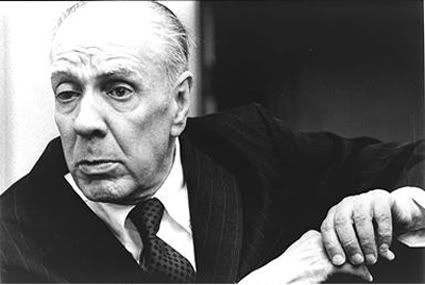 I read the first few stories in The Book of Sand several months ago and never got around to finishing them, but while browsing in the library the other day I found it again and decided to finish it. My personal favorites from the collection are the fairy-tale-like "The Mirror and the Mask" and the straightforwardly dreamlike "The Other," though Borges states in the introduction that he believes two different stories in the collection, "The Book of Sand" and "The Congress", to be some of his "greatest works in short fiction." He also mentions in "The Bribe" what he calls something like "the peculiar determined predilection of Americans to be even-minded." That was a bit surprising to me, as I've always tried to be exceptionally even-minded and noticed the predilection of many of my acquaintances, whether I agree with their opinions or not, to tend to regard people who disagree with them as utter fools. (Notice that I attempt to show my own even-mindedness by adding the cautionary "whether I agree with their opinions or not." Heheh.)
I am ashamed to say that much of the preceding was referenced from Wikipedia, which as everyone knows is a highly suspicious website and probably not the best place to get your information from, since any Joe Schmo can upload any crap he likes and people will assume it as fact until it gets taken down. Consider the case of John Seigenthaler Sr. as evidence of Wikipedia's spuriosness.
While poking around in the dictionary for a good word to use in place of the cumbersome "spuriousness," which sounds akin to words like "spokesperson" in construction, I found an amazing array of similar-sounding words meaning "doubtful," that is, not "worthy of being doubted" (which is what I was looking for with "spuriousness") but "in a state of doubt": dubitancy, dubiety, dubiosity, dubiousness, or doubtfulness. Amazing concoction, the English language.
Tuesday, January 2, 2007
Bibliotheca
bibliotheca \,bih-blee-oh'thee-kuh\
1 archaic : BIBLE
2 : a library or collection of books
3 : a list or catalog of books
I read a lot, though I haven't been reading as much for the past month or so due to the immense amount of stuff I've had to do. Generally I read literature, classic novels and so on, with the occasional indulgence like Artemis Fowl or The Rule of Four, interspersed with a lot of plays (as I'm a drama nerd), biographies, science books, history books, and whatever else I feel like. Being homeschooled gives me some choice as to what I can read and don't have to read, since my parents don't micromanage my reading list and generally assume that I'm reading something good. If they walk by and see me holding The Master and Margarita or One Flew Over the Cuckoo's Nest, they can walk away with satisfied smiles.
As an example of the sort of stuff I read, here is my reading list (which I keep diligently, one might almost say obsessively) for the past few months. The presence of a reading list somehow encourages me to read more so that I'll have something to put on the list, especially at the end of each month.
October
The Rule of Four- Ian Caldwell & Dustin Thomason
Stuff Happens- David Hare
Mother Courage and Her Children- Bertolt Brecht
Nehru- Shashi Tharoor
Uncommon Carriers- John McPhee
Purity of Blood- Arturo Perez-Reverte
The New Life- Orhan Pamuk
Three Tall Women- Edward Albee
Impromptu- Tad Mosel
No Exit- Jean-Paul SartreNovember
The Children's Hour- Lillian Hellman
The Clothes They Stood Up In & The Lady in the Van- Alan Bennett
The Duck Variations- David Mamet
Freakonomics- Steven D. Levitt and Stephen J. Dubner
Oh, Play That Thing- Roddy Doyle
Invisible Cities- Italo CalvinoDecember
Blue Door- Tanya Barfield
Bad Science- Gary Taubes
Strange Pilgrims- Gabriel Garcia Marquez
Jesus' Son- Denis Johnson
The Shia Revival- Vali Nasr
While looking at this reading list at one point, and the entire year's worth of books listed before it, I noticed how woefully lacking it is in female authors. My selection of subject material is wide and various, and authors of many nationalities are represented on this list, but there are really very few women, aside from a disproportionate number of female black playwrights- Suzan Lori-Parks, Lynn Nottage, Tanya Barfield, and Lorraine Hansberry, for example. Am I just subliminally sexist? Are there just not that many books written by women? The latter explanation does not account for this woeful shortage.
So to rectify this abominable situation, encouraged by my mom's plan to read more books by femal authors (specifically, if I recall, American female authors), I've decided to increase the female-penned segment of my reading list. This happens to coincide with the New Year but has nothing to do with it- I don't make New Year's resolutions because I never keep them and therefore it's a waste of time. Some of the female authors I'm planning to read are E. Annie Proulx, Toni Morrison, Carson McCullers, Harper Lee, Alice Walker, Lillian Hellman, Wendy Wasserstein, Marilynne Robinson, and maybe even Joan Didion, Joyce Carol Oates, or (egads!) Willa Cather. Not all at once, of course; I'm still going to intersperse these with scientific books (Darwin, Dawkins, Feynman, Hawking, Sagan), plays (Albee, Ionesco, Pinter, Shepard, O'Neill, Soyinka), biographies (MLK Jr., actors like Alec Guinness or John Gielgud, political leaders/revolutionaries), and plenty of novels by men (some that spring to mind are Schindler's List, Child of All Nations, The Satanic Verses, In the Lake of the Woods, and On the Road).
I'll keep you posted.
Monday, January 1, 2007
Anacrusis
Though anacrusis has several specific definitions and does not actually mean the commencement of just anything, I'm sure I can extend it metaphorically to mean "commencement of just anything" (such as a blog) without the Semantic Police locking me away. But anyway, this blog is going to deal with a variety of subjects, primarily cultural/artistic matters (such as literature, music, theater, film, etc.) as well as linguistics, hockey, politics, and other things which I find significant. I'll also try to provide a Word of the Day with each post, which may or may not have any bearing on the actual content of the blog, with words which I think are cool or useful.anacrusis \an-a'kroo-sis\ noun
1 : one or more syllables at the beginning of a line of poetry that are regarded as preliminary to and not a part of the metrical pattern of that line
2 : UPBEAT; specifically : one or more notes or tones preceding the first downbeat of a musical phrase — called also pickup
3 : a preparatory gesture leading into an accented or climactic dancing movement
I'm a student from Montana who's been considering a blog for quite a while now, and since a couple of my family members have joined Blogspot I figured I would conform. I may not post very often, as I have many other exciting things to be doing with my life in general, but meh, c'est la guerre.
Subscribe to:
Comments (Atom)